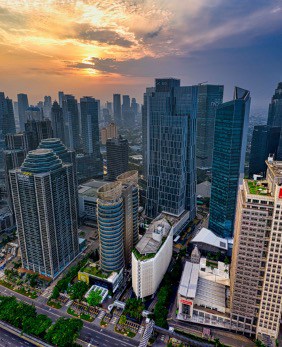
Indonesia is not the easiest place to start a business. But, according to the world bank that has upgraded Indonesia’s status to “Upper Middle-Class Income” country is one of the reasons why you should do business in Indonesia. Other than that, Indonesia is poised to be the top 4th biggest economy in the world by 2050 and the population here in Indonesia is more than 267 million with more than around 20% population categorized as Middle Class & Affluent Customers (MAC). To successfully start and expand a business it is important to establish a good network in Indonesian business and government circles.
The present government is focusing on making it easier to foreign investors to establish their presence in Indonesia. The government has recently removed the Negative Investment List and replaced it with Priority Investment List. Now the government has introduced a new Online Business Licensing system called Online Single Submission (OSS) to make it easier and faster to apply for business licenses. The current ranking in Indonesia for Ease of Doing business is 73 but it is expected to improve with the implementation of the new Omnibus Law.
Luckily, it is not difficult to establish these networks as foreign businessmen are also interesting parties for Indonesians. It is highly recommended to become acquainted with cultural values beforehand to know how to socialize with Indonesian business partners and Indonesian employees as well as to grasp Indonesia’s business culture. This will make your business more efficient and effective, especially in the long term.
Omnibus Law & Priority Investment List
As part of the implementing regulations to the Omnibus Law (Law No. 11 of 2020), the government introduces a new investment list to replace the Negative Investment List under Presidential Regulation No. 44 of 2016 and Presidential No. 76 of 2007. The new investment list, aptly titled Priority Investment List, is issued under Presidential Regulation No. 10 of 2021 on Investment Business Activities.
In the Priority Investment List, permitted and restricted sectors have been simplified, and instead of navigating a long list of businesses that foreign investors cannot invest in, they can now target the desired business and comply with the necessary conditions.
BUSINESS ACTIVITIES WHICH ARE CLOSED IN INDONESIA
- Cultivation and industry of narcotics.
- Industry of chemical weapons manufacturing.
- All forms of gambling and/or casino activities.
- Industry of industrial chemicals and industry of ozone-depleting substances.
- The capture of any Endangered species of fish according to the Convention on International Trade in Endangered Species of Wild Fauna and Flora (CITES).
- Utilization and collection of coral and utilization and collection of corals from nature which are used for building materials/limestone/calcium, aquarium, and souvenirs/jeweler, as well as live and dead coral (recent death coral) from nature.
- Industry of alcoholic drinks and wine.
*This article is written by Arissa Redea Shafie for HReasily

Find out about Arissa Redea Shafie on LinkedIn
See it on your own numbers.
Start free, import your team, and run a cycle on real hours. Nothing is filed until you approve it.
Sign up for free